Do tokenized stocks pay dividends?
Ondo and xStocks both reinvest dividends automatically, but show it differently. Why one tokenized NFLX trades at $99 and another at $893

You just bought a tokenized stock onchain. You excitedly share it with your friend in TradFi. He asks: "Did you receive the dividend this quarter?" You pause, not fully sure. You open your wallet. The balance looks roughly the same, maybe. No cash showed up. Nobody contacted you. There's no statement to check.
Another friend in Web3 says he bought the same stock on a different platform/issuer. His token price is at $99, yours is at $893. He thinks you're holding something else entirely.
You're both right. You just don't know why yet.
These are the questions every onchain investor runs into eventually. Let's walk through how dividends and corporate actions actually move through tokenized stocks.
What are Dividends
In traditional equity markets, a dividend is a corporate cash distribution paid directly to shareholders. That said, a tokenized stock backed 1:1 should not leave you out of dividends. In fact, dividend delivery is one of the clearest proofs that the token is genuinely backed by a real share.
First, let’s map out some dividend-paying stocks and compare them with their tokenized versions.
This is also a good time to check whether you hold any of these assets!
How Dividends Are Distributed Onchain
Because tokens live in self-custodial Web3 wallets, mailing physical checks or managing individual bank routing numbers is impossible. Instead, platforms automate the distribution by taking the net dividend proceeds and reinvesting them directly back into the underlying physical security. This allows your asset exposure to compound natively onchain.
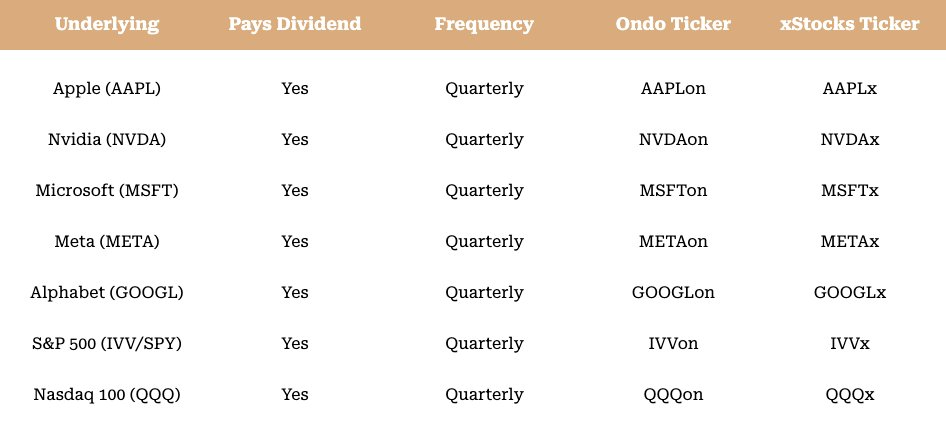
Notable absentees: Tesla, Netflix, Amazon have never paid a cash dividend. Traditional dividend payers like JPMorgan and Coca-Cola are not yet supported on either tokenized platform.
How Dividends Are Distributed Onchain
Because tokens live in self-custodial Web3 wallets, mailing physical checks or managing individual bank routing numbers is impossible. Instead, platforms automate the distribution by taking the net dividend proceeds and reinvesting them directly back into the underlying physical security. This allows your asset exposure to compound natively onchain.
Here is how Ondo & xStocks idefine this on their platforms:
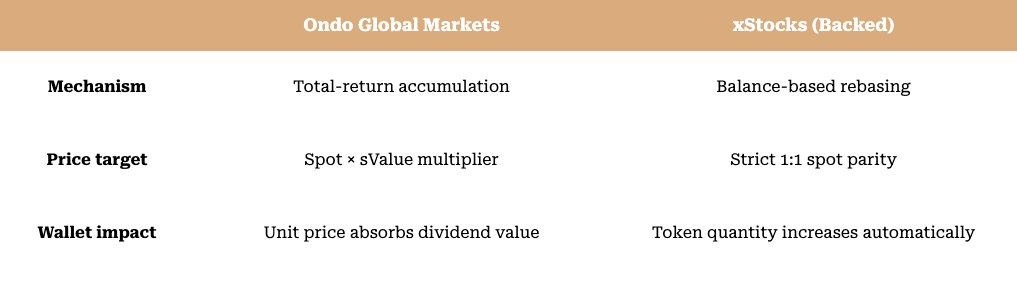
Ondo Global Markets:"Ondo tokenized stocks and ETFs are total-return trackers that mirror the economic performance of their underlying assets. Dividends are automatically reinvested net of applicable tax withholdings and reflected in token pricing."
xStocks (by Backed):"xStocks are designed to reflect the price and behavior of traditional stocks. These are 'rebasing assets,' meaning their balances automatically adjust in response to corporate actions like stock splits or dividends."
The simple takeaway
Both platforms automatically reinvest your dividends to compound your holdings. They just show you the result in completely different ways.
Ondo keeps its raw onchain token supply static. Instead of giving you more tokens, it increases an internal multiplier (sValue). One raw Ondo token now represents slightly more than one underlying share, causing the token's economic value to drift upward over time.
xStocks focuses on keeping a strict 1:1 price peg with Wall Street. When more shares are purchased via dividends, the smart contract triggers a rebase event. It updates an internal mint multiplier so your wallet automatically scales upward to show a larger token balance while the unit price stays aligned with the traditional stock.
Over time, this means each tokenized stock can represent slightly more of the real underlying shares. For example, 1 tokenized NVDA could eventually represent 1.0035 real NVDA shares.
Note: Because these tokens are managed by offshore entities on behalf of non-U.S. investors, U.S. corporate dividends face a flat 30% international withholding tax before reinvestment. You compound at 70% efficiency compared to a domestic account.
That covers dividends. The same multiplier logic becomes even more visible during stock splits, where the difference between “raw token value” and “displayed market price” can suddenly look extreme.
Aside from Dividends: How About Stock Splits?
When a company executes a major corporate event like a stock split, traditional brokerages simply modify a row in a centralized database.
On a public blockchain, you cannot easily rewrite immutable onchain data structures or force-update thousands of independent user wallet balances simultaneously. Doing so could be expensive, inefficient, and operationally messy.
Case Study: The Netflix 10-for-1 Stock Split
On November 17, 2025, Netflix (NFLX) split its stock ten-for-one. The traditional share price dropped from roughly $1,089 down to an adjusted opening price of $108.90, while outstanding shares multiplied by ten. To handle this sudden change, token issuers updated their onchain multipliers to 10.0. But because they chose different underlying structural models, the displayed prices diverged dramatically.
See image:
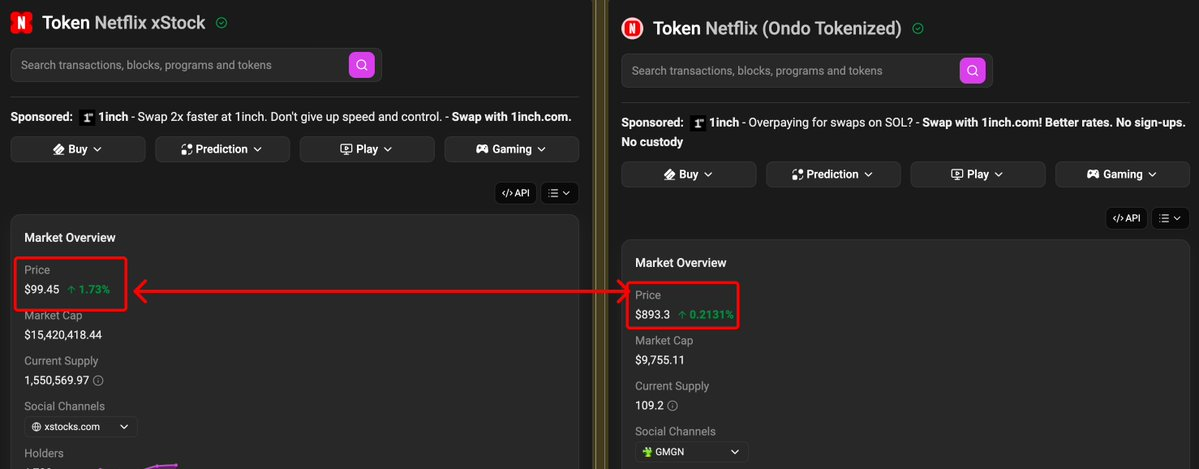
Netflix tokenized price variance on Solscan: NFLXx at $99.45 vs NFLXon at $893.30
xStocks (NFLXx)
The xStocks model enforces strict spot parity. It uses the multiplier to beautify the frontend. When interfaces read the multiplier correctly, they display ten times the token balance at the post-split market price of roughly $99.
Ondo (NFLXon)
Ondo uses the Total-Return model. It leaves the raw token price unscaled to track the absolute economic value of your initial capital. One raw Ondo token now represents ten split-adjusted shares, meaning its unscaled oracle price feed reads roughly $893.
This brings us back to the opening scenario: you see $893, your friend sees $99, and both numbers are right.
The underlying value of your investment is the same. Your friend’s platform used a backend scaling mechanism to keep the displayed token price close to the traditional stock price. Your platform kept the raw token value unscaled, so one token now represents the value of multiple post-split shares.
Closing Notes
To summarize, onchain architecture gives tokenization issuers an engineering choice when corporate restructurings hit. Some protocols use the multiplier to beautify the frontend interface, multiplying your displayed token units so the unit price stays pegged 1:1 with the new market spot price. Others stick to the token’s historical total-return accumulation, leaving raw token counts unscaled so a single token can absorb the value of multiple post-split shares.
This 10x visual difference on public explorers is a minor quirk of merging public blockchains with traditional equity data. But navigating frontends is only half the battle when the trading clock goes 24/7.
What happens when traditional stock exchanges close for the evening while the blockchain keeps running? Does the token price stay locked, or does localized crypto demand create massive premiums and discounts?
That is what the next article in this series will cover: the mechanics of 24/7 continuous trading and onchain market decoupling.
About Treasures
Treasures is a Neobrokerage-as-a-Service solution built on tokenized stocks, powering stock trading in neobanks, AI agent ecosystems and hedge funds. Our SmartRoute aggregator routes across all of the leading issuers and blockchains to offer the deepest catalog in the market, with over 2,000 tokenized stocks available today. Our Copytrade and Signals products surface alpha from well-known market participants - allowing both our users and integrators to access high-quality asset curation. Over the next few weeks, we will be launching Onchain SMAs, our flagship institutional B2B offering connecting traditional asset managers with corporate clients onchain. With a single integration to the Treasures API or Agent Skill, partners can now launch full-fledged neobrokerage services in just a matter of hours.
Trade at app.treasures.io: https://app.treasures.io
Build with the Treasures API: https://docs.treasures.io
Follow Treasures on X: https://x.com/treasures_io