What happens to tokenized stock prices on weekends?
Tokenized stocks don’t erase the weekend gap. They turn it into a price you can see before Monday. Here’s how far it drifts, with data.

Stocks might still feel completely bizarre to someone who started their trading journey in crypto. Imagine you buy a share of a stock on Friday. A massive news headline breaks on Saturday morning, and you can do nothing but sit and wait until the market opens on Monday. You have probably seen catchy slogans promising 24/7 stock trading onchain, but the actual mechanics are far more complicated than keeping an app open over the weekend.
Let’s start with a common misconception.
After-hours stock trading already exists in traditional finance. Institutions frequently use private trading venues known as dark pools, where buy and sell interest is hidden before execution. These venues are often used by institutions that want to trade large blocks without showing the full order to the public market.
Most retail investors do not directly interact with dark pools. Their broker may route orders through off-exchange channels, but the retail user is not directly choosing dark pool counterparties or viewing hidden institutional liquidity.
Dark pools also do not create a full public weekend market, so the structure is still closer to 24/5 than true 24/7. Wall Street has been trying to stretch its hours. NYSE Arca is targeting nearly continuous weekday trading, 23 hours a day from 9:00 PM to 8:00 PM ET, five days a week, subject to regulatory approval and market infrastructure readiness. But even that structure remains 24/5 rather than a deep, public Saturday and Sunday equity market.
Web3 rails start from a different assumption. They have shown that settlement can happen continuously, and market access can be global. How does it work? Let’s break it down.
Weekends: The Shift from Live Market Anchor to Secondary Price Discovery
During standard Monday through Friday market hours, tokenized stock venues can lean on issuer-linked liquidity, market-maker quotes, and RFQ-style execution.
What happens during weekends?
When the underlying U.S. stock market is closed, that live market anchor becomes weaker or unavailable. Market makers can reference the last official close, prior overnight trading context, related derivatives, CEX order books, DEX liquidity pools, and macro headlines. But over the weekend, the cleanest input is missing: a live, hedgeable Nasdaq price.
You can think of it like a prediction market for where the stock price may be when the market reopens.
How far can weekend drift go?
Probably the first question that pop up immediately, will the price variance goes so far beyond market makers are unable to reconcile with it? A published study by Cong, Landsman, Rabetti, Zhang, and Zhao in December 2025 gave us a useful baseline to test it.
They tracked the tokenized equity markets from **July 2025 through October 2025**. In the paper’s Sep-Oct 2025 sample, significant weekend mispricings above 5% were absent for Tesla xStock and Tesla Ondo. Nvidia and Alphabet tokens had low slippage, mostly under 2%, while Tesla was more volatile.
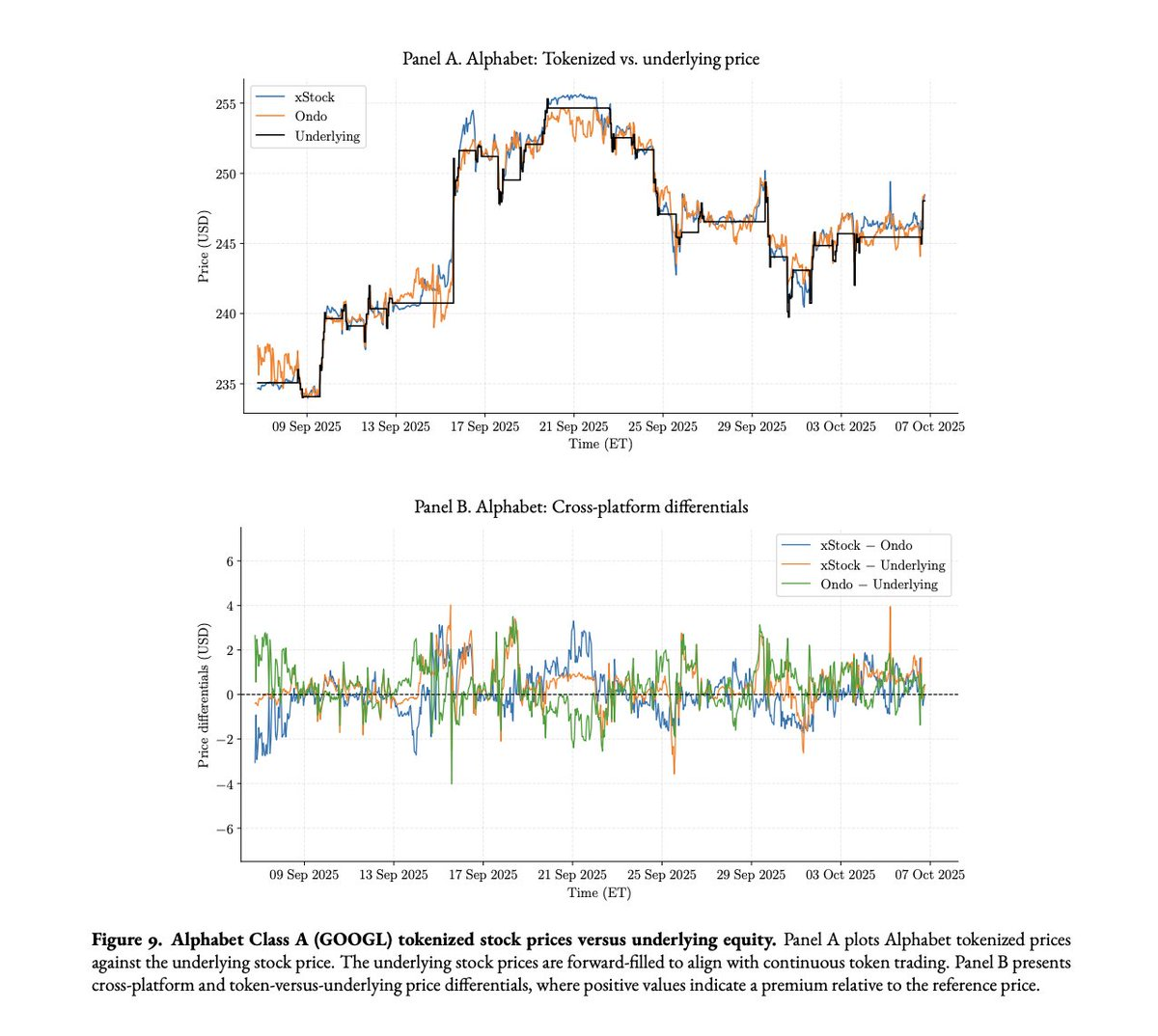
Source: TOKENIZED STOCKS by Cong, Landsman, Rabetti, Zhang, and Zhao
The study finds evidence that tokenized stocks can incorporate value-relevant news in real time and act as an off-hours price discovery layer. Weekend token movements can anticipate Monday returns, smoothing what would otherwise appear as sharper gaps at the open.
You can access the full research here:
https://papers.ssrn.com/sol3/papers.cfm?abstract_id=5937314
If we compare it with today?
When the study observed the market in late 2025, tokenized equities were a highly efficient but small-scale retail arena, with around 400M in market cap. Today, according to Token Terminal, the overall tokenized equity market cap has moved past roughly $1.3 Billion milestone, tripling the $400 million baseline recorded during the research.
Trading access also improved. DEX aggregators and routing venues such as Jupiter and 1inch make liquidity easier to reach, though execution quality still depends on the asset, venue, order size, and market depth.
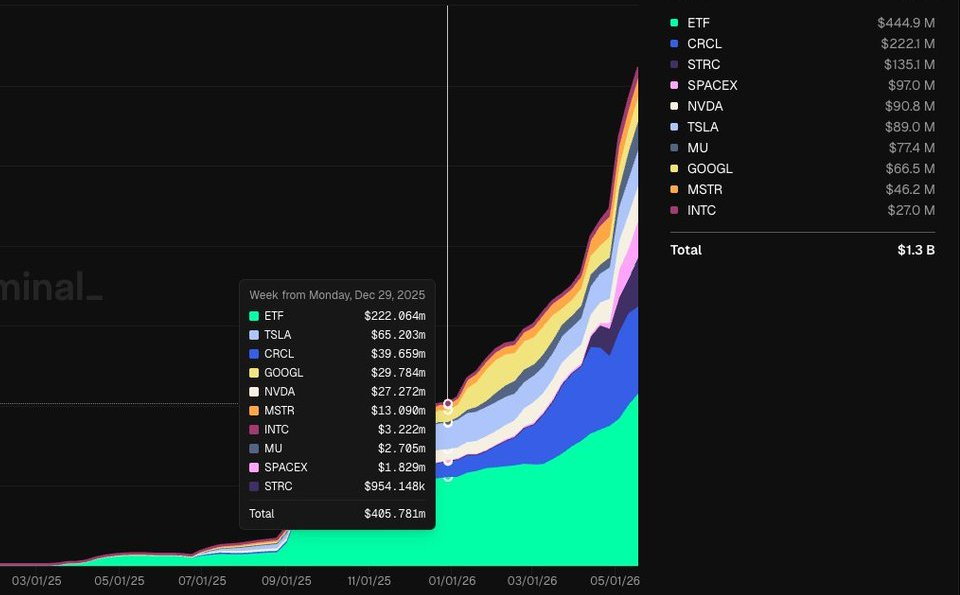
Source: Token Terminal - Projected tokenized stock growth from 2025 to 2026
Putting the Data into Practice: A Case Study
A clear example of weekend price discovery unfolded during the April 11 to April 12, 2026 weekend. Nvidia closed regular trading on Friday, April 10 at $188.63.
The macro backdrop shifted over that weekend as U.S.-Iran peace talks broke down and markets reacted to renewed Strait of Hormuz risk. While traditional equity investors had to sit tight with no active Nasdaq session to react to the developing news, tokenized markets provided continuous tracking.
The NVDAON token traded through the weekend on CoinGecko. One weekend snapshot captured NVDAON trading at $188.47 on Friday night minutes after market closes.
The tokenized asset spent the weekend searching for fair value as macro headlines shifted. Over Saturday and Sunday, trading pushed NVDAon through several volatile waves, with intraday peaks around $189.04 and $189.19 as participants priced the anticipated Monday reaction.
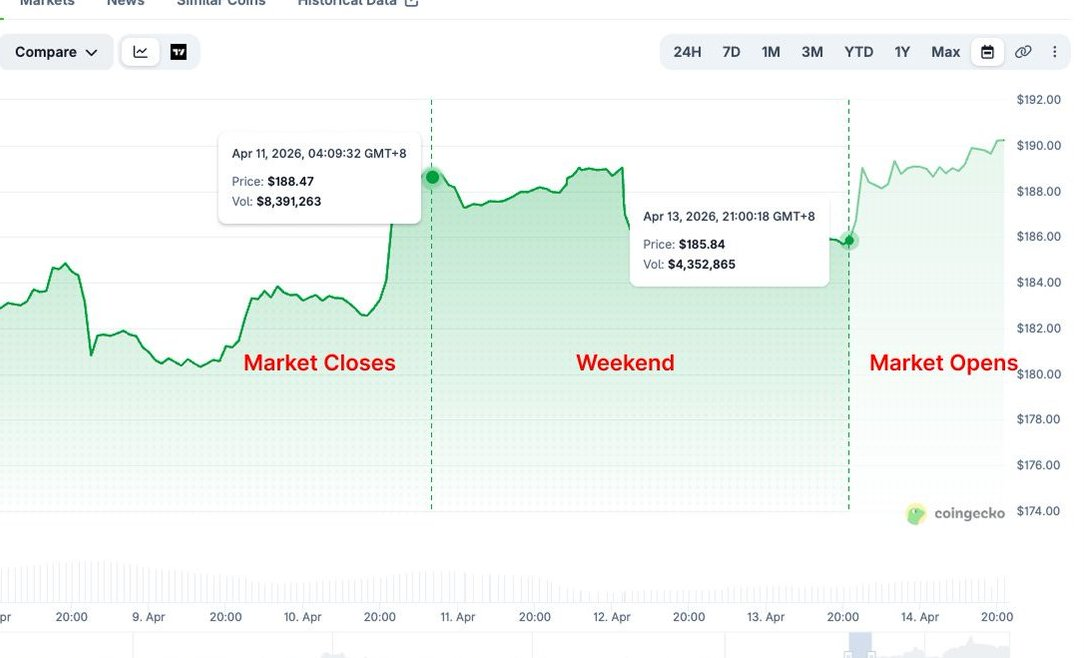
As the traditional open approached, the tokenized asset moved closer to the eventual Monday opening level. By Monday, April 13, just moments before the traditional opening bell, an on-chain snapshot caught NVDAON at $185.84. When the regular U.S. market finally opened a few hours later, the underlying stock gapped down slightly from Friday's close but aligned tightly with the weekend's late on-chain activity, officially opening at $186.03.
This specific price action offers a useful stress test of the historical baseline established by the 2025 Cornell and NUS study.
The research previously found that tokenized blue-chip stocks maintained remarkably tight pegs, with deviations mostly staying under 2% during off-hours, crossing that line only a fraction of the time (just 8% of weekend hours for volatile assets like Tesla). The April 2026 event tracks this behavior beautifully. While the weekend peak of $189.19 represented a mere 0.30% variance from Friday's anchor, the sharp dip to $184.15 temporarily pushed the token to a 2.38% deviation.
Rather than a systemic break, this brief move past the 2% threshold showed the parallel market actively testing boundaries under macroeconomic pressure before stabilizing near the Monday open.
To summarize, tokenized stocks do not erase the weekend gap completely, but they turn it into a visible market signal before traditional markets reopen.
About Treasures
Treasures is a Neobrokerage-as-a-Service solution built on tokenized stocks, powering stock trading in neobanks, AI agent ecosystems and hedge funds. Our SmartRoute aggregator routes across all of the leading issuers and blockchains to offer the deepest catalog in the market, with over 2,000 tokenized stocks available today. Our Copytrade and Signals products surface alpha from well-known market participants - allowing both our users and integrators to access high-quality asset curation. Over the next few weeks, we will be launching Onchain SMAs, our flagship institutional B2B offering connecting traditional asset managers with corporate clients onchain. With a single integration to the Treasures API or Agent Skill, partners can now launch full-fledged neobrokerage services in just a matter of hours.
Trade at app.treasures.io: https://app.treasures.io
Build with the Treasures API: https://docs.treasures.io
Follow Treasures on X: https://x.com/treasures_io