How do tokenized stock issuers back their tokens?
The five layers behind every backed tokenized stock: broker-dealer, custodian, issuer SPV, security agent and oracle.

Imagine being in the shoes of a tokenized stock issuer today. What do you need? Who do you need to work with? What has to be in place before you mint a token? Bringing a stock onchain means bridging two worlds that were genuinely not designed to talk to each other.
- In the Nasdaq model, the tokenized security is meant to be the same security in a new settlement format, with the same rights and the same regulatory treatment.
- In the crypto-native model, the user holds a structured note, a tracker certificate, an SPV-backed claim, or in some cases synthetic exposure.
Until recently, tokenized stocks mostly lived in a gray zone between traditional securities law and crypto-native market structure. Recent reports show the SEC is preparing an innovation exemption for tokenized stocks, potentially creating a framework for trading digital versions of publicly traded securities, but the details remain pending until the SEC publishes the framework.
@100y_eth and @FourPillarsFP published a detailed breakdown of the various classifications of tokenized securities and how they map to the SEC's own terminology. Worth reading alongside this article:
https://x.com/100y_eth/status/2056754733772411323?s=20
For an onchain investor, whether the model is exchange-led, SPV-backed, direct-tokenized, or crypto-native, the same question always comes back:
What does the token actually represent?
The Stack Behind Every Serious Issuer
A serious tokenized stock issuer usually needs five core layers:Broker-dealer → Custodian → Issuer entity → Security agent → Oracle and token contract
Layer 1: The Broker-Dealer
A tokenized stock issuer does not buy Apple or Tesla "onchain." It needs access to regulated brokerage infrastructure that can source, execute, clear, and custody the underlying U.S. equities through traditional market rails.
Alpaca Securities has become one of the primary rails in this market. According to Alpaca, it clears over 94% of tokenized U.S. stocks and ETFs, representing more than $480 million in tokenized assets under custody.
This is the first bridge between the token and the real-world stock.
Layer 2: The Custodian
After the share is purchased, someone has to hold it in a segregated account, separate from the issuer's operating funds. Token holders rely entirely on this backing structure, and without proper segregation, the holder's claim becomes materially weaker in a default scenario.
In many current tokenized U.S. equity structures, the broker-dealer and custody function overlap. Alpaca handles both in some structures, though the exact arrangement varies by issuer and product.
Layer 3: The Issuer Entity
The issuer entity is the legal vehicle that actually mints the token. Different issuers use different structures depending on the asset and the jurisdictions they want to reach. For example:
Ondo Finance
Ondo Finance uses Ondo Global Markets (BVI) Limited, a bankruptcy-remote SPV organized in the British Virgin Islands. Its tokenized stocks are structured as debt instruments. The token holder is, legally speaking, a secured creditor of an offshore entity, not a shareholder of Apple or Tesla.
xStocks
xStocks uses Backed Assets (JE) Limited, a Jersey SPV. Its products are bearer debt instruments or tracker certificates, collateralized by the corresponding underlying assets.
Prestocks
PreStocks takes a different angle, focusing on pre-IPO private company exposure rather than listed equities. Its tokens track the price of pre-IPO companies and are backed by SPV exposure to underlying shares. The structural difference is significant. Private company shares typically require board approval for transfers, while public equities on Nasdaq or NYSE carry no such restriction. That single distinction can separate structures that are easier to defend from those that may come under regulatory scrutiny.
In all three SPV-backed models, the holder owns economic exposure through the issuer structure, linked to the value of the underlying asset. To be explicit: as a token holder, you are not a shareholder of Apple or Tesla. You are a secured creditor of an offshore SPV.
Layer 4: The Security Agent
The security agent is the party that helps protect token holders if something goes wrong with the issuer.
For example, Ondo describes its structure as giving token holders a first-priority security interest in the assets backing the tokens, held by a third-party security agent.
xStocks uses a similar protection idea. Its product legal overview says that if the issuer defaults, the Security Agent may take control of the collateral accounts, liquidate the underlying assets, and distribute proceeds to token holders according to the prospectus terms.
In a default scenario, recovery still depends on the legal documents, jurisdiction, custodian, broker, collateral value, and whether the holder is eligible to receive proceeds.
But it is a major difference between a serious backed product and an unbacked synthetic. Without a security agent or equivalent enforcement mechanism, token holders may have a much weaker path to recover value in an issuer default.
Layer 5: Oracle and Token Contract
Once the share is bought, held, and wrapped in a legal structure, the product still needs an onchain representation.
The token contract defines how the asset behaves: how it transfers, which chain it lives on, how supply changes, and how corporate actions are reflected.
The oracle layer brings real-world pricing data onchain. An oracle tells a protocol the reference value of Apple stock. It does not guarantee a user can sell their tokenized position at that exact price on a DEX.
The executable price is whatever the AMM or RFQ system offers, which can diverge from the oracle reference during thin trading periods or when markets are closed.
Example:
Ondo uses Chainlink Data Streams for its oracle and market-data layer. xStocks uses Chainlink Proof of Reserve for reserve verification, with weekly onchain attestations that anyone can check programmatically.
On Ethereum and EVM chains, these assets typically use ERC-20-style contracts or compliance-aware extensions. On Solana, Token-2022 mechanics support transfer controls, display adjustments, and corporate-action handling.
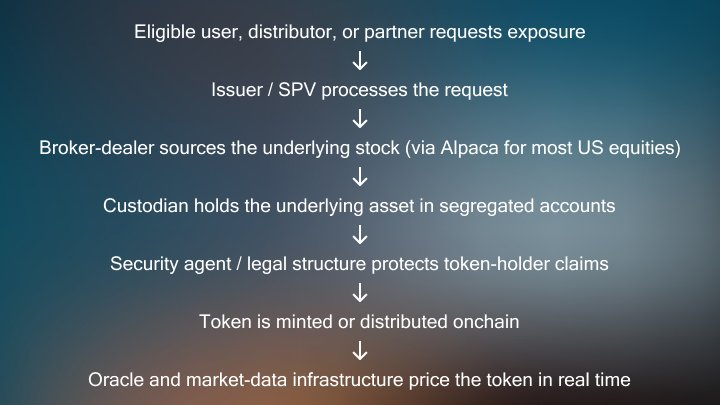
The Full Tokenized Stock Flow: Simplified
Backing the Share is Only Half the Story
When a company pays a dividend in traditional finance, the shareholder usually receives cash, or the broker reinvests it through a dividend reinvestment plan.
Tokenized stocks add another layer to that pipeline. If the issuer structure is the one holding the underlying shares, then the cash dividend first flows into that structure. What happens next?Does the token holder receive cash? Does the dividend get reinvested?
That is what our third article in this series will cover: stock dividend payouts.
About Treasures
Treasures is a Neobrokerage-as-a-Service solution built on tokenized stocks, powering stock trading in neobanks, AI agent ecosystems and hedge funds. Our SmartRoute aggregator routes across all of the leading issuers and blockchains to offer the deepest catalog in the market, with over 2,000 tokenized stocks available today. Our Copytrade and Signals products surface alpha from well-known market participants - allowing both our users and integrators to access high-quality asset curation. Over the next few weeks, we will be launching Onchain SMAs, our flagship institutional B2B offering connecting traditional asset managers with corporate clients onchain. With a single integration to the Treasures API or Agent Skill, partners can now launch full-fledged neobrokerage services in just a matter of hours.
Trade at app.treasures.io: https://app.treasures.io
Build with the Treasures API: https://docs.treasures.io
Follow Treasures on X: https://x.com/treasures_io