How do Ondo tokenized stocks work? A front-to-back case study
You hold NVDAon. Behind it: a BVI note, a security agent, 30% withholding, shares per token, and a 24/5 clock. The whole stack, in order.

You just bought your first tokenized stock onchain. You picked up $NVDAon, excited that you now have exposure to Nvidia without opening a brokerage account. The process is simple. Connect wallet, route the order, receive the token.
Then the real questions start.
Do you actually own Nvidia stock? Who holds the underlying share? What happens if Ondo fails? Are you legally allowed to hold this? Where do dividends go? Can you trade it when Nasdaq is closed?
Every tokenized stock holder runs into these questions eventually. Most users buy the token first and figure out what they actually bought afterward.
This article walks Ondo Finance from the user experience backward through the legal wrapper, backing stack, dividends, market hours, and DeFi surface.
Why Ondo Finance?
Ondo Finance started with tokenized treasury products before moving deeper into tokenized equities. OUSG and USDY gave the company a track record with regulated assets and custody structures before Ondo Global Markets launched.
Today, Ondo Global Markets supports more than 200+ tokenized stocks and ETFs, including Tesla, Nvidia, QQQ, SPY, TLT, TIP and AGG. RWA.xyz shows tokenized stocks at roughly $1.55B in distributed value as of early June 2026, with Ondo leading at $973M and roughly 62% market share.
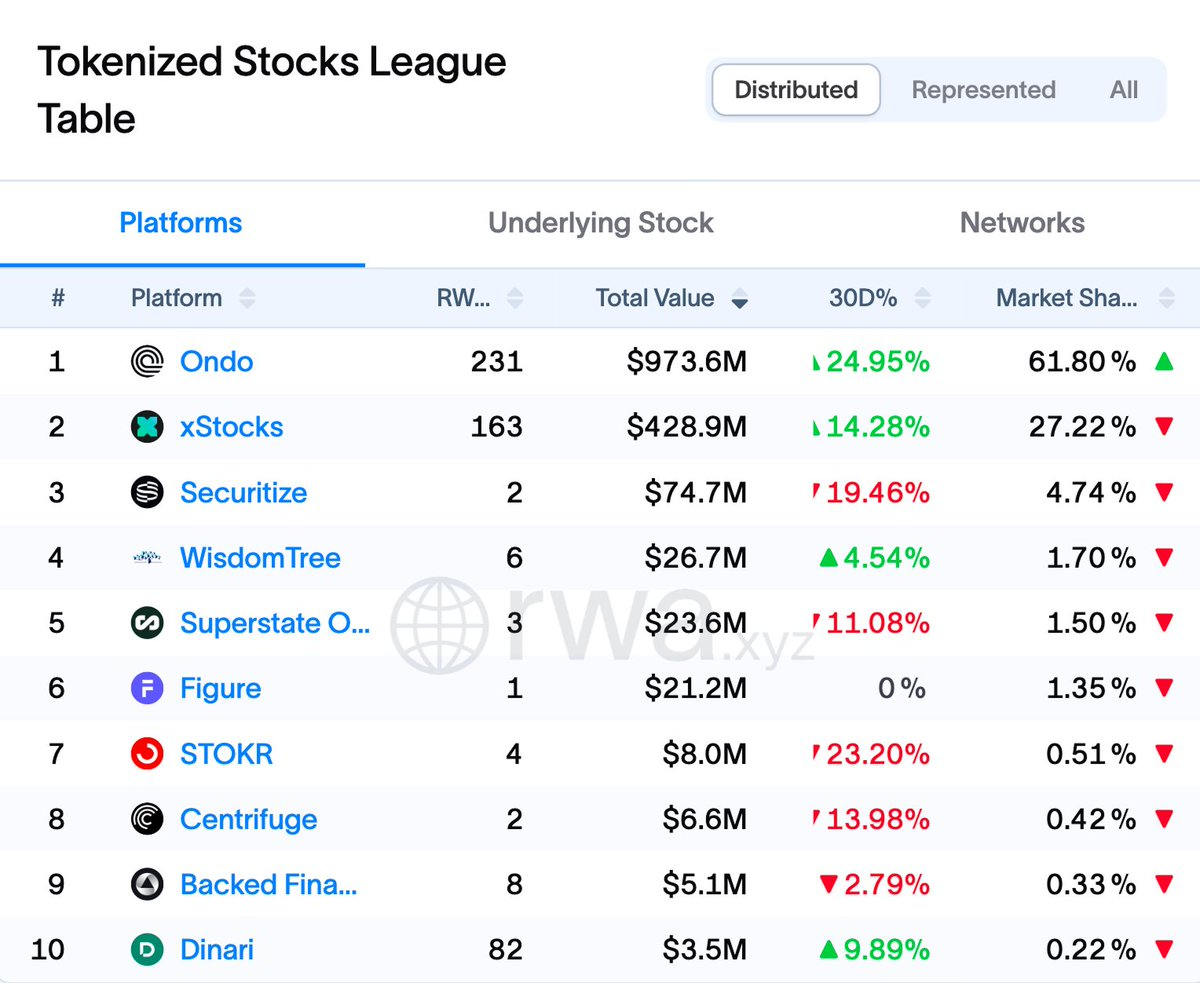
Ondo leads the tokenized stocks category with roughly 62% market share as of June 2026
That makes Ondo one of the largest and most established tokenized stock issuers, and a useful case study for understanding how these products work in production.
What You Are Actually Buying
When you buy NVDAon, the token is designed to give you economic exposure to Nvidia. Your legal position differs from being listed directly as an Nvidia shareholder.
Ondo tokenized stocks are structured as debt instruments issued by Ondo Global Markets (BVI) Limited, a bankruptcy-remote SPV organized in the British Virgin Islands. The note pays out based on the value of the underlying asset, including corporate actions such as dividends, spin-offs and acquisitions.
The underlying securities are held through regulated custodial broker-dealer infrastructure, and tokenholder claims are supported by a first-priority security interest in the collateral.
In simple terms, you get onchain exposure to familiar U.S. public-market assets. Your legal relationship runs through the issuer structure rather than the company's shareholder register.
Two Ways to Get Ondo Tokens
The first path is the primary market through Ondo’s RFQ system. Eligible users complete onboarding and KYC, then quote and execute trades directly with Ondo Global Markets.
The second path is the secondary market. After tokens are minted, they can move across supported blockchains and appear in venues such as 1inch on Ethereum, Jupiter on Solana, or PancakeSwap on BNB Chain. The smart contract layer may not require Ondo onboarding before a user interacts with a secondary venue.
This is the gap between technical access and legal entitlement. A user may technically find $NVDAon on a DEX. Redemption access, offering rights, and legal eligibility still depend on Ondo’s terms, KYC requirements, jurisdictional rules, and securities laws.
Market Hours and Secondary Liquidity
Ondo Global Markets is designed around 24/5 availability rather than a full weekend market. The platform is generally available from Sunday evening through Friday evening in New York time, covering pre-market, core session, post-market, and overnight trading windows.
Secondary markets sit at a different layer. Ondo does not guarantee that a secondary market will exist, that liquidity will be available, or that secondary-market prices will match the issuer’s quote or reference value. A DEX pool can keep existing liquidity available outside Ondo’s primary trading flow, but the quality depends on liquidity providers, market makers, spreads, and user demand.
During supported weekday sessions, Ondo’s quote flow can stay closer to the underlying stock market because the issuer can reference live market infrastructure. Outside those windows, secondary liquidity can become thinner, and prices may drift from the underlying reference value.
Academic research by Cong, Landsman, Rabetti, Zhang and Zhao found that tokenized stocks tracked underlying equities closely during regular trading hours, with modest deviations on weekends. For blue-chip names, weekend deviations rarely exceeded 2%.
The practical takeaway: users should expect the cleanest execution during supported market hours. Outside those windows, pricing becomes more dependent on local liquidity.
Dividends and Shares Per Token
Imagine Apple pays a dividend. With Ondo, the dividend flows first to the issuer structure that holds the underlying. For U.S. company dividends, brokers generally withhold 30% before the remaining amount is reinvested.
Ondo’s total-return tracker model means tokens reflect both price movement and reinvested dividends. Over time, one token can represent the economics of more than one underlying share. Ondo calls this “shares per token.”
Assume $AAPL trades at $320 and $AAPLON starts with one token representing one share. After a quarterly dividend and 30% withholding, the remaining cash buys 0.001 additional shares. One AAPLon token now represents 1.001 Apple shares. Repeated across quarters, the ratio compounds.
The token price can drift above the regular stock quote over time. The token tracks total return rather than only spot price.
On Solana and BNB Chain, Ondo supports Scaled UI. Wallets that integrate it display balances closer to the underlying stock’s unit price. Wallets that do not may show the Ethereum-style total-return presentation. The economic exposure is the same, the display differs.
Can You Use It in DeFi?
Ondo tokenized stocks are built for public blockchain rails. A user can hold the token in a supported wallet, transfer it across networks, route it through venues with liquidity, and potentially use it in lending markets.
Morpho already supports markets using Ondo tokenized ETFs as collateral. A user holding SPYon or QQQon can supply those assets into selected Morpho vaults and borrow USDC against them. These markets were created by Gauntlet, which sets and monitors risk parameters such as collateral factors, borrow caps, liquidation thresholds, and oracle configurations around the assets.
The surface is still early. Exact supported collateral assets, caps, curators, LTVs and oracle configurations should be checked directly on live protocol pages.
The question has moved beyond whether the ticker exists onchain. Can it be routed with acceptable slippage? Can smart contracts hold it? Can an oracle price it? Can a lending market accept it? Can liquidation infrastructure handle stress?
Tokenized stocks will be judged by how many tickers can be traded with usable depth, priced reliably, routed cleanly, supplied as collateral, and composed into strategies.
The Trade-Offs
A user buying Ondo tokenized stocks is choosing equity-linked exposure through an offshore SPV structure with creditor rights via a first-priority security interest rather than direct shareholder status.
You accept dividend reinvestment net of withholding taxes rather than cash dividends in your wallet. You accept a total-return model where token price may differ from the Wall Street quote. You accept 24/5 platform availability, while secondary-market liquidity may still exist outside the primary flow with weaker guarantees and thinner pricing. DeFi utility depends on real liquidity, routing, oracle support, and lending-market parameters.
In exchange, you get onchain exposure to U.S. stocks and ETFs across supported wallets and chains, assets that can move through crypto rails, interact with DeFi infrastructure, and potentially become collateral.
The product is a structured, backed, onchain financial instrument designed to make public-market exposure behave more like a DeFi asset.
Closing the Series
Ondo Finance shows the full stack in one place. The user sees NVDAon. Behind it sits a structured note, a BVI issuer, underlying securities, regulated custody, market-hour constraints, dividend reinvestment, shares per token, Scaled UI, supported chains, and early DeFi composability.
The next wave of users will start by buying a tokenized stock. The winners will be the platforms, issuers, protocols and interfaces that can answer what they own.
About Treasures
Treasures is a Neobrokerage-as-a-Service solution built on tokenized stocks, powering stock trading in neobanks, AI agent ecosystems and hedge funds. Our SmartRoute aggregator routes across all of the leading issuers and blockchains to offer the deepest catalog in the market, with over 2,000 tokenized stocks available today. Our Copytrade and Signals products surface alpha from well-known market participants - allowing both our users and integrators to access high-quality asset curation. Over the next few weeks, we will be launching Onchain SMAs, our flagship institutional B2B offering connecting traditional asset managers with corporate clients onchain. With a single integration to the Treasures API or Agent Skill, partners can now launch full-fledged neobrokerage services in just a matter of hours.
Trade at app.treasures.io: https://app.treasures.io
Build with the Treasures API: https://docs.treasures.io
Follow Treasures on X: https://x.com/treasures_io