Stock perps vs spot Tokenized Stocks: What does it cost to hold a position?
A $10,000 long perp at 0.03% funding pays $270 a month to stay open, right or wrong. Spot pays nothing. When each one is the right tool.

If you trade crypto, perps may feel like the only way to get equity exposure onchain. The UX is familiar, markets are 24/7, and you would size the trade the same way for crypto. But if your view on $SPCX, $TSLA , $NVDA , $MU, or the S&P 500 is meant to last weeks or months, do you still want to rent that exposure through a perp, or hold the spot version directly?
Perps opened the first door
For most crypto traders, the first real version of stock exposure onchain came through perps, Hyperliquid made that behavior feel natural. With HIP-3, builders could deploy their own perp markets, and equity-linked products started appearing next to the assets crypto traders already touch every day.
If a trader wants a view on stocks without opening a brokerage account, the first instinct is now to check the perp market. Stock perps deserve credit for solving the access problem. A trader could open the position from the same environment they already used for crypto.
Perps are also excellent when the intent is tactical. They give you leverage, shorting, hedging, and fast execution. They let you express a view immediately, with less upfront capital, around the clock. In a strong trend, a well-timed perp can beat spot because you can lever up and recycle capital faster.
The tradeoff is that a perp is still a derivative. The longer the position stays open, the more your return depends on variables beyond the stock move itself. Funding, basis, liquidation risk, oracle behavior, and margin management all become part of the trade.
Case Study: The hidden variable of funding
The main cost of a perp is often not the entry fee. It is funding.
Funding keeps the perp price close to the underlying reference price. When demand leans to one side, that side pays the other. Positive funding means longs pay shorts. Negative funding means shorts pay longs.
The detail that matters is that funding is paid on your full position notional, not just the margin you posted. A trader using 2,000 dollars of margin to hold 10,000 dollars of exposure still pays funding on the full 10,000.
To isolate it, assume a trader wants 10,000 dollars of stock exposure with no leverage. One buys spot. One opens a 10,000 dollar long perp. Ignore entry fees, spreads, and slippage, so the only variable is funding. (See below)
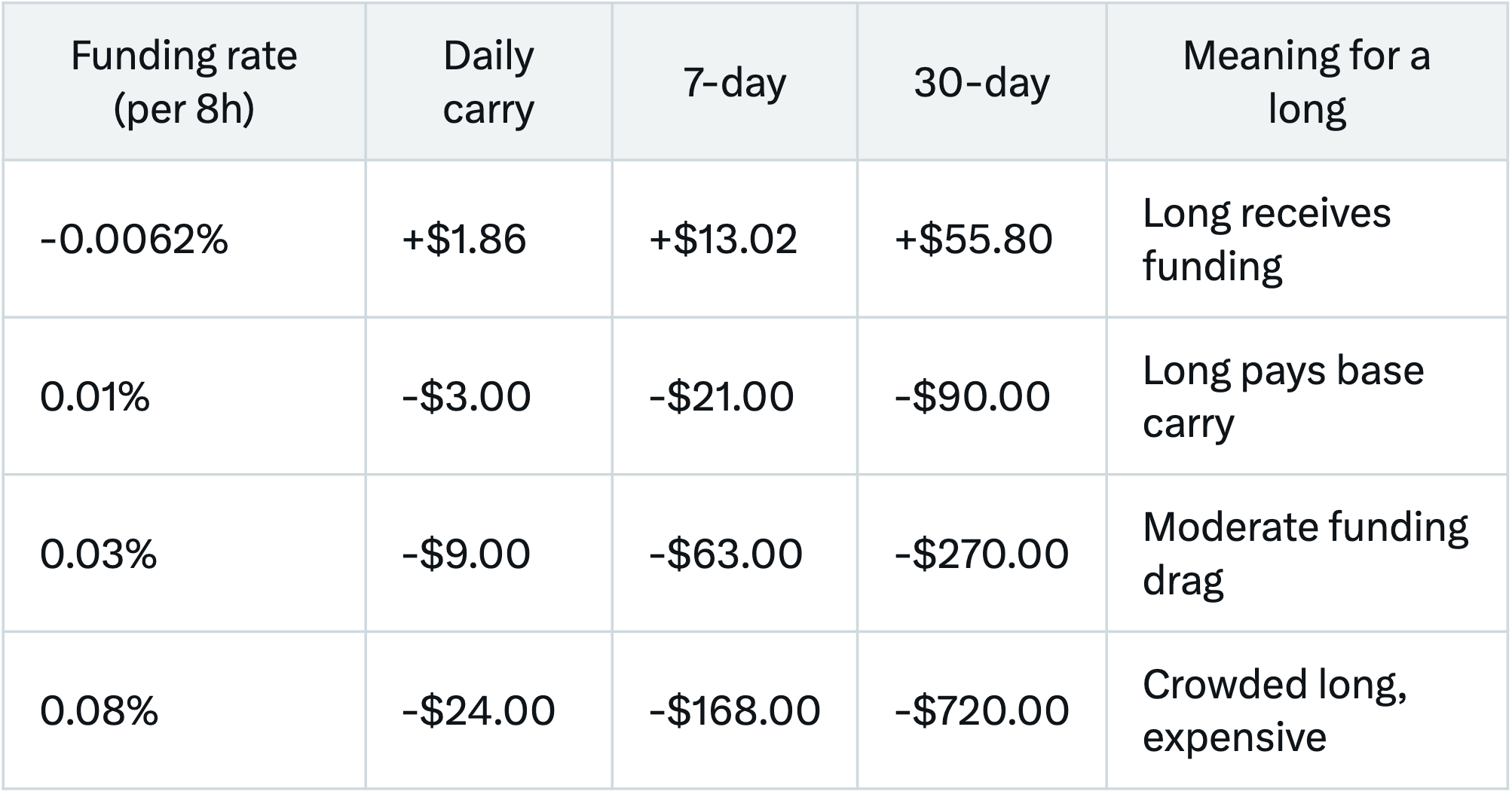
These rates are illustrative snapshots, since live funding moves continuously.
That table is the core of the argument. A perp can be the right instrument and still carry that recurring cost. Spot carries no funding at all. It does not remove price risk, a spot holder still loses if the stock falls, but it takes the funding variable out of the holding decision entirely.
What the funding drag looks like in practice
Take a 10,000 dollar position and hold funding at 0.03 percent per 8h, roughly 0.09 percent a day. Run it through a stock that rises, and the same stock if it falls.
When the view is right:
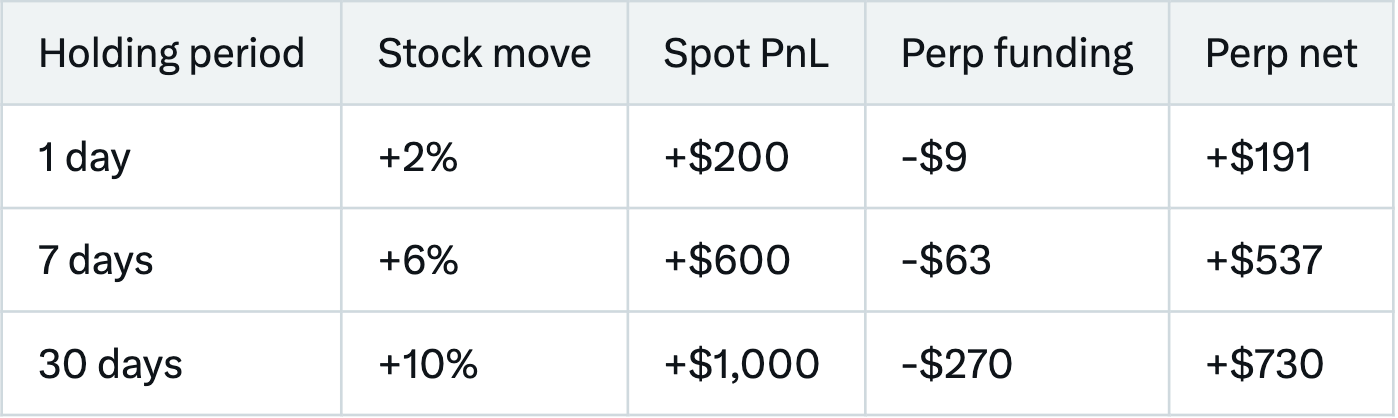
The trade was correct in every period and the perp still made money. Over one day the gap is a rounding error. Over a month, funding quietly takes a real share of the return, and if the stock only drifts higher, that share grows.
When the view is wrong:
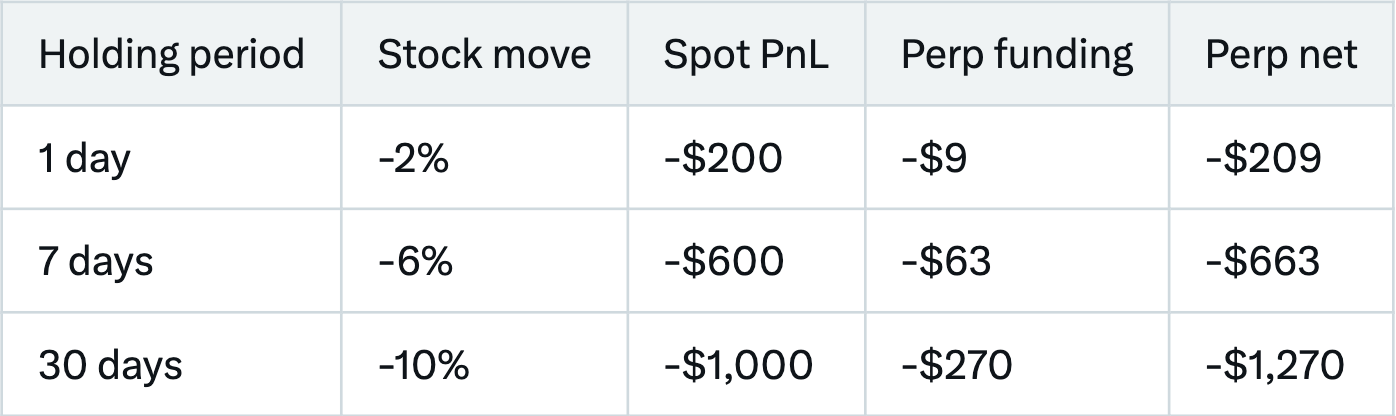
In this case, you are wrong on direction and still pay to keep the position open. A spot holder is down on the move and nothing more. A long perp during positive funding is down on the move plus the carry. Add leverage and liquidation risk stacks on top.
Many stock views are not one-day trades. A thesis on AI infrastructure, an earnings catalyst, rate cuts, index inclusion, or plain company fundamentals can take weeks or months to play out. A spot holder can sit through the drawdown and wait. A leveraged perp trader can be right over a longer horizon and still get liquidated before the view arrives.
A fair pushback for perps
A fair comparison has to admit on perps. Funding is not always a cost. When it turns negative, a long perp gets paid to hold. Using the same 10,000 dollar position at −0.0062 percent per 8h, the long receives about 55.80 dollars over 30 days, which lifts the perp above spot at every outcome.
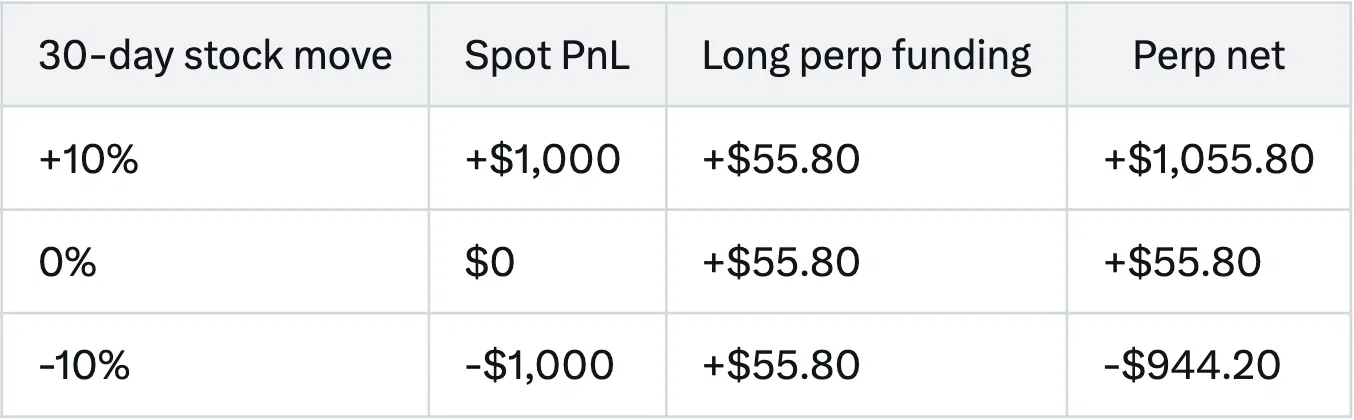
The fair thesis is not that spot always wins. It is that spot removes funding uncertainty. Sometimes funding helps you, sometimes it barely registers, and sometimes it eats into the return. A tactical trader may want that variable in play. A long-term holder usually does not want it in the position at all.
The horizon decides the answer. The shorter the trade, the more perps make sense, because a sharp one-session move makes funding a rounding error and leverage and liquidity matter more. The longer the position stays open, the more the instrument itself starts to drive the outcome.
The future of onchain equities
The future of onchain equities is not perps versus spot. It is the right instrument for the right job. Perps stay essential for leverage, shorting, hedging, and fast tactical exposure. Spot tokenized stocks matter for holding equity exposure from crypto rails without funding drag or liquidation risk on an unlevered position. One trades the view, the other owns it. And for an AI agent managing a portfolio, ownership is far easier to reason about than a position carrying funding and liquidation variables that shift every eight hours.
Perps made stock exposure tradeable for crypto users. Spot tokenized stocks make that exposure something you can hold. That is the shift Treasures is built around. As tokenized equities grow, traders and agents will need to compare issuers, chains, venues, prices, liquidity, backing models, and execution routes before they act. The market is getting larger and more fragmented at the same time, and Treasures brings it into one access layer.
Stock perps opened the first door for crypto traders. Spot tokenized stocks open the next one.
About Treasures
Treasures is a Neobrokerage-as-a-Service solution built on tokenized stocks, powering stock trading in neobanks, AI agent ecosystems and hedge funds. Our SmartRoute aggregator routes across all of the leading issuers and blockchains to offer the deepest catalog in the market, with over 2,000 tokenized stocks available today. Our Copytrade and Signals products surface alpha from well-known market participants - allowing both our users and integrators to access high-quality asset curation. Over the next few weeks, we will be launching Onchain SMAs, our flagship institutional B2B offering connecting traditional asset managers with corporate clients onchain. With a single integration to the Treasures API or Agent Skill, partners can now launch full-fledged neobrokerage services in just a matter of hours.
Trade at app.treasures.io: https://app.treasures.io
Build with the Treasures API: https://docs.treasures.io
Follow Treasures on X: https://x.com/treasures_io