What are the different types of tokenized stocks?
Perpetuals, SPV-issued products and direct tokenization explained, plus why Mirror, Binance and FTX stock tokens failed. The wrapper decides what you own.

If you've been DeFi-native for years, owning an asset feels self-explanatory. It sits in your wallet, secured by a private key, and you can move it anywhere, any time. Equities don't work that way. A stock is not just an asset in an account. It is a bundle of legal rights attached to a company’s shareholder register, which is why tokenized stocks need more scrutiny than most tokens.
A share of common stock may include:
- Voting rights on board elections and major decisions
- Dividend rights, a claim on profits the board distributes
- Liquidation rights, a residual claim on assets if the company winds down
- Information rights, audited financials, proxy materials
A share is a position on a legal register that grants enforceable claims against a real corporation. Even in traditional finance, you probably don't own the stock directly. When you buy AAPL through a brokerage app, you are usually a beneficial owner, not the registered shareholder. The registered holder is typically Cede & Co., DTC’s nominee, while brokers and clearing firms maintain the customer-level records.
A simplified version looks like this:
Apple → Transfer Agent → Cede & Co. / DTC → Clearing Broker → Robinhood → You
Cede & Co., DTC’s nominee, is the registered holder for most DTC-eligible U.S. public equities held in street name.
Now bring that onchain. The same ticker can sit behind very different instruments, and the wrapper determines what the holder actually owns.
1. Mirror Protocol
One of the most famous early onchain stock experiments was not backed by real shares. Mirror let users mint synthetic stocks, mAAPL, mTSLA, by overcollateralizing with UST and LUNA. mAssets were pure synthetics backed by crypto collateral. In October 2021, a $90M exploit drained the protocol silently. When UST collapsed in May 2022, the collateral evaporated with it.Mirror users never held anything tangible. When the collateral died, so did the claim.
2. CEX-Issued/Distributed Stock Tokens
Early CEX-issued or CEX-distributed experiments included Binance Stock Tokens and FTX tokenized stocks.In this model, the exchange may be the main user interface, trading venue, and distribution channel. The legal issuer, broker, or custody relationship may sit elsewhere, but the user’s practical dependency is still heavily tied to the platform.That created two problems.
- Regulatory pressure. Binance’s stock-token product faced scrutiny from regulators and was discontinued within months.
- Platform risk. FTX’s tokenized stock products showed what happens when the trading venue itself becomes the failure point. When FTX collapsed, holders were left dealing with platform failure and bankruptcy processes, not a simple app-to-shareholder redemption path.
The lesson: when the CEX is the main interface, venue, and user dependency, the product can still inherit the exchange’s solvency, operational, and regulatory risk, even if the legal issuer or broker sits elsewhere.
Today, the market has moved beyond those early experiments.
Three main models now shape how tokenized stocks are issued, traded, and used onchain.
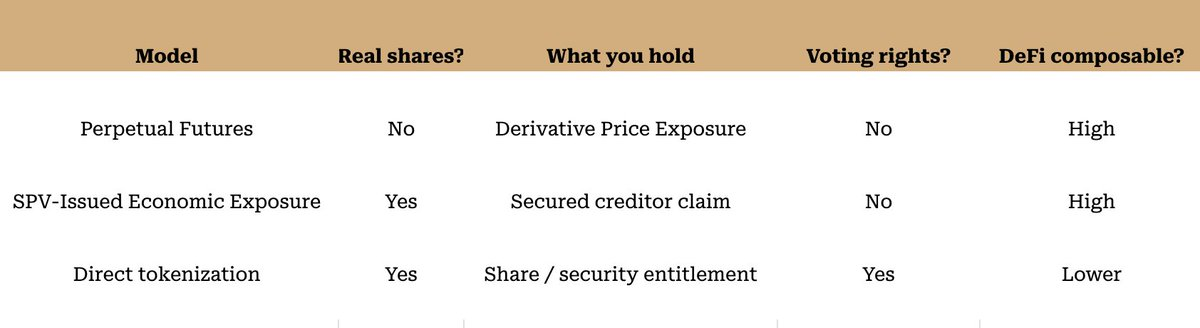
Synthetic/Perpetual
Example: Hyperliquid
Perpetual futures give traders price exposure to stocks or stock-like assets without owning the underlying shares. The user is trading a contract that tracks price through funding rates, oracle references, and market liquidity.This model can be highly liquid and useful for speculation, hedging, or basis trades. But it is not ownership, and it does not give the holder any claim on the underlying shares.Perps are relevant because they compete for trader attention and can complement tokenized stocks in strategies, but they should not be confused with backed stock ownership.
SPV-Issued Economic Exposure
Examples: Ondo Finance, xStocks
This is the dominant model today.A special purpose vehicle issues the tokenized product. The SPV or its service providers acquire, hold, or reference real shares through regulated broker-dealer and custody infrastructure.The onchain token represents an instrument linked to the value of the underlying stock, such as a structured note or tracker certificate.In this model, a user receives economic exposure to the stock. Depending on the product design, this may include price movement, dividend treatment, and 24/7 onchain transferability across supported chains. But users generally cannot vote, because their legal relationship is with the issuing vehicle, not directly with the underlying company.
Direct Tokenization
Example: Securitize, Superstate
Direct tokenization is the model where the blockchain token is designed to represent the security itself, or a direct record of ownership in the security, rather than a separate note or synthetic tracker.
In this structure, the token is closer to the actual share or security entitlement. The investor may have stronger ownership rights because the asset is recorded through a regulated transfer-agent or issuer-controlled system, rather than through an offshore SPV issuing a debt claim linked to the stock.
That means wallets may need to be KYC-approved, jurisdictions may be restricted, transfers may require compliance checks, and protocols interacting with the token may need to be whitelisted.
Tokenized stock is not a single category.
The same familiar ticker can sit behind very different instruments. That distinction matters because the wrapper determines almost everything the user actually experiences.
The next question is: how are these products actually built?When a tokenizer brings a stock onchain, someone has to buy or source the underlying share.
Someone has to hold it. A legal entity has to issue the tokenized instrument. A broker, custodian, transfer agent, market maker, or security agent may sit somewhere in the stack.
Our second article will go one layer deeper.
We will unpack how tokenizers structure these products behind the scenes: how the underlying share is purchased, who holds it, what legal entity issues the token, and what the holder actually has a claim on.
About Treasures
Treasures is a Neobrokerage-as-a-Service solution built on tokenized stocks, powering stock trading in neobanks, AI agent ecosystems and hedge funds. Our SmartRoute aggregator routes across all of the leading issuers and blockchains to offer the deepest catalog in the market, with over 2,000 tokenized stocks available today. Our Copytrade and Signals products surface alpha from well-known market participants - allowing both our users and integrators to access high-quality asset curation. Over the next few weeks, we will be launching Onchain SMAs, our flagship institutional B2B offering connecting traditional asset managers with corporate clients onchain. With a single integration to the Treasures API or Agent Skill, partners can now launch full-fledged neobrokerage services in just a matter of hours.
Trade at app.treasures.io: https://app.treasures.io
Build with the Treasures API: https://docs.treasures.io
Follow Treasures on X: https://x.com/treasures_io